Orthosomnia: When Sleep Tracking Starts Hurting Your Sleep
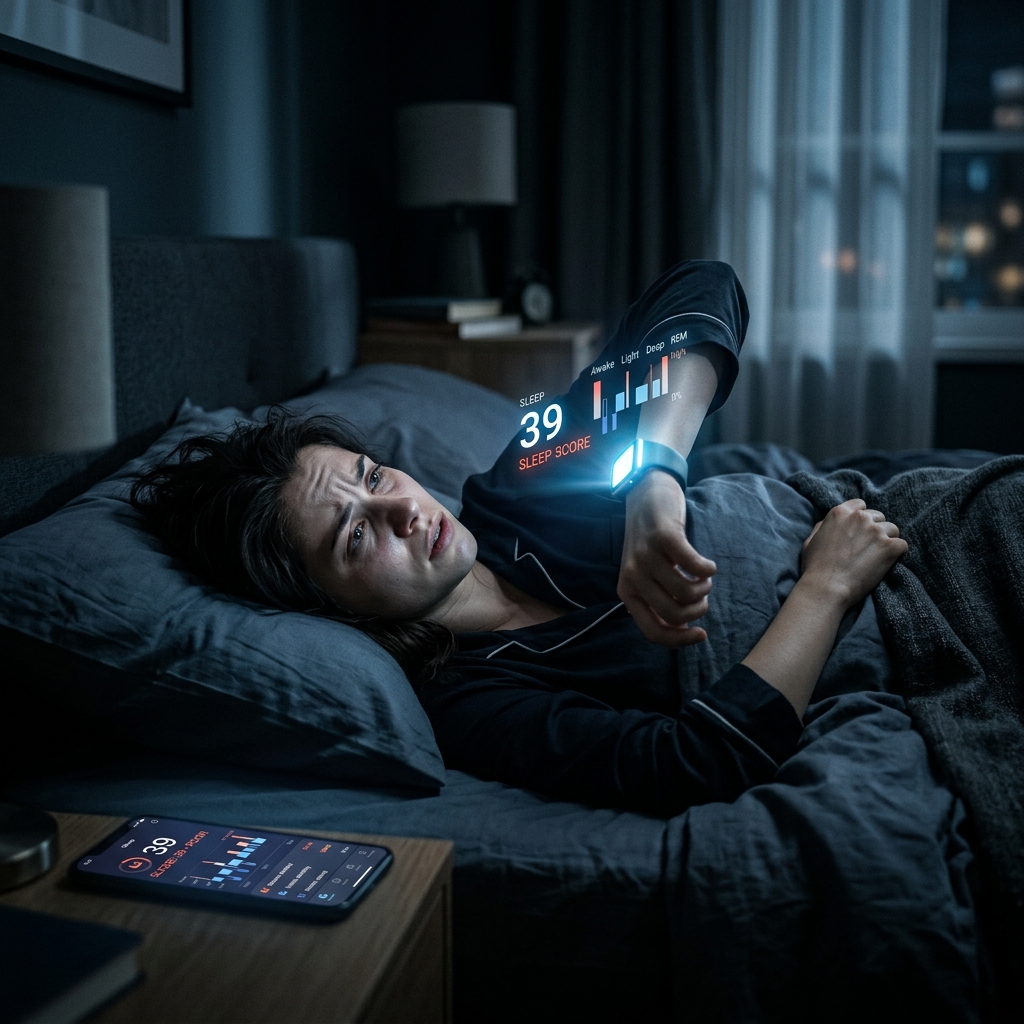
You bought a sleep tracker to fix your sleep. Instead, you wake up, check your score, see a disappointing number, and spend the rest of the day wondering what you did wrong. If that sounds familiar, you're not imagining it. For some people, wearables like the Oura Ring, WHOOP, Apple Watch, or a mattress-based tracker do something helpful: they create awareness, reveal patterns, and encourage better habits. But for others, they quietly turn sleep into a nightly performance review. That's the core of orthosomnia, and it's becoming a very real problem in 2026.
Orthosomnia is the obsessive pursuit of perfect sleep data. The term was introduced by sleep researchers in 2017 after they noticed patients arriving in clinics with graphs, scores, and screenshots, but worse sleep than before they started tracking. Instead of using data as a rough guide, they were using it as a threat signal. A "bad" score created anxiety. Anxiety increased physiological arousal. That arousal made sleep worse the next night. Then the bad score confirmed the fear. It's a neat, cruel loop.
If you've ever wondered, "Does sleep tracking make sleep worse?" the honest answer is yes, sometimes. But not because trackers are inherently bad. They become a problem when the data changes your relationship with sleep.
What Orthosomnia Actually Means
Orthosomnia is not a formal psychiatric diagnosis. It's a descriptive term used in sleep medicine to capture a pattern: people trying so hard to optimize their sleep metrics that they end up sleeping worse. "Ortho" means correct or straight, and the phrase basically translates to an unhealthy fixation on getting sleep "right."
This matters because sleep is one of the few biological processes that gets worse when you try to force it. You can support it, protect it, and create good conditions for it, but you cannot bully yourself into sleeping better. Once your brain starts treating sleep like a score to win, your nervous system often shifts in the opposite direction.
That is why people with orthosomnia often say things like:
- "I felt okay until I saw my readiness score."
- "My Oura Ring says I slept terribly, but I thought I slept fine."
- "I'm anxious before bed because I don't want another bad sleep score."
- "I wake up at night and immediately wonder how this will affect my deep sleep."
Those are not harmless thoughts. They're cues that sleep has stopped being restorative and started becoming evaluative.
Why Sleep Trackers Can Backfire
Sleep trackers are not measuring sleep directly the way a clinical sleep lab does. Most consumer devices estimate sleep using movement, heart rate, heart rate variability, temperature trends, and sometimes respiratory proxies. That can be useful, but it is still an estimate.
And estimates become dangerous when people treat them as absolute truth.
Here are the main ways sleep tracking can start hurting sleep:
1. The score becomes more important than how you feel
The biggest red flag is when subjective sleep gets replaced by device authority. You wake up feeling decent, then see a low score and suddenly decide you're exhausted. That expectation effect matters. Research on placebo and nocebo responses consistently shows that beliefs shape how we experience symptoms. If a wearable tells you that your sleep was poor, you're more likely to interpret normal tiredness as evidence that something is wrong.
2. It increases pre-sleep pressure
People with insomnia already tend to monitor sleep too closely. A tracker can intensify that tendency. Instead of thinking, "I'll rest and let sleep come," the mind shifts to, "I need enough deep sleep, enough REM, a good recovery score, and ideally no wakeups." That performance pressure is basically rocket fuel for sleep anxiety.
3. Nighttime awakenings become more threatening
Waking briefly during the night is normal. Most healthy sleepers do it and fall back asleep without even remembering. But if you're wearing a tracker and mentally translating each awakening into lost points, those ordinary moments feel high stakes. Then you fully wake up, because now you're worried.
4. Device inaccuracies create false alarms
Consumer trackers are reasonably decent at estimating total sleep time, but they are much less reliable at sleep staging. Deep sleep and REM numbers can vary meaningfully from lab-based polysomnography. If you're making decisions or panicking based on a stage estimate that may be wrong, the tracker is not helping.
5. It reinforces hypervigilance
Good sleep requires a degree of letting go. Orthosomnia does the opposite. It trains you to monitor, evaluate, and react. Hypervigilance is one of the classic drivers of insomnia, and some people accidentally build more of it every time they refresh last night's data.
Five Signs Your Sleep Tracker Is Hurting More Than Helping
Not everyone who uses an Oura Ring or WHOOP has a problem. A lot of people benefit from the accountability. The question is whether your device is improving behavior without increasing anxiety.
You may be drifting into orthosomnia if:
1. You check your sleep score before checking in with your body
If the first thing you do in the morning is ask your app how you slept instead of noticing how you actually feel, the tracker has probably become too influential.
2. A bad score changes your mood for the whole day
If one disappointing number makes you cancel workouts, expect brain fog, or catastrophize the day ahead, that's a sign the data is driving your psychology more than your physiology.
3. You feel bedtime pressure because the device is watching
This is subtle but common. You don't just want sleep. You want a better score. That turns bedtime into a test.
4. You mentally calculate the impact of every wake-up
If you're awake at 2:17 AM thinking about lost REM, readiness, or recovery metrics, your tracker is now participating in your insomnia.
5. You have more data, but worse peace of mind
This is probably the clearest sign. Tracking should create clarity. If it's creating confusion, compulsive checking, and sleep-related anxiety, the tradeoff is bad.
What the Science Says About Sleep Tracking and Anxiety
The formal research on orthosomnia is still young, but the mechanism is highly plausible and increasingly supported by what we already know about insomnia. Cognitive models of insomnia show that selective attention to sleep, catastrophic thinking about daytime consequences, and effortful attempts to control sleep all contribute to persistent sleep problems.
That's almost a perfect description of how anxious tracking can behave.
Recent coverage from major outlets and psychologists in 2025 and 2026 reflects the same concern: trackers can help with awareness, but they can also amplify sleep-related perfectionism. People who are already prone to anxiety, obsessive tendencies, or insomnia seem especially vulnerable.
This doesn't mean the Oura Ring is "causing" insomnia in every case. It means the tracker can become a delivery system for sleep anxiety in people whose nervous systems are already sensitized.
When Sleep Trackers Actually Do Help
I don't think the right answer is "throw all wearables in a drawer forever." That's too simplistic.
Sleep trackers can be genuinely useful when they're used for pattern detection rather than nightly judgment.
They tend to help most when:
- you're comparing trends over 2 to 4 weeks, not obsessing over one night
- you're using them to spot behavior patterns, like alcohol wrecking sleep or late workouts raising heart rate
- you're emotionally able to treat the data as approximate, not definitive
- you don't already have active insomnia or strong sleep anxiety
- you can ignore the stage-by-stage details and focus on broad signals
For example, if your tracker helps you notice that late-night drinking consistently raises resting heart rate and fragments sleep, that's useful. If it helps you realize that a regular bedtime improves recovery trends over a month, also useful.
The key distinction is whether the device is helping you make calmer decisions or making you more reactive.
Oura Ring Anxiety, WHOOP Stress, and the "Always On" Problem
Oura Ring anxiety is becoming its own mini-category online because the product is good enough to feel credible and polished enough to feel authoritative. That's a potent combination. When a sleek app presents readiness, resilience, sleep stages, and recovery in a clean dashboard, it's easy to forget you're still looking at consumer-grade estimates.
WHOOP can create a similar issue, especially for high-performers who already think in terms of optimization. If everything becomes strain, recovery, readiness, and performance, sleep may stop feeling like a human need and start feeling like a KPI.
That's the deeper problem. Trackers don't just provide data. They shape attention. And attention changes experience.
If your device makes you more aware of how alcohol, late meals, blue light, or stress affect sleep, great. If it makes you feel surveilled, judged, and tense, it has crossed the line from feedback into friction.
What to Do if Sleep Tracking Is Making Your Sleep Worse
If you suspect your sleep tracker is hurting sleep, don't start with an all-or-nothing reaction. Use a stepped approach.
Step 1: Hide the score for 2 weeks
If your app allows it, stop checking nightly scores first thing in the morning. You can still wear the device, but delay looking at the data until later in the day, or review only weekly trends. That small change creates psychological distance.
Step 2: Go back to subjective sleep markers
For the next 7 to 14 days, track these instead:
- How long did it feel like it took to fall asleep?
- How many times do you remember waking up?
- How rested do you feel on waking, from 1 to 10?
- What was your energy like by late morning?
- Did anything obvious affect sleep, like alcohol, stress, a hot room, or late food?
This matters because your actual experience of sleep is still clinically important. Sleep medicine is not just about graphs.
Step 3: Focus on environment over metrics
If you're trying to improve sleep, the biggest wins usually come from a cooler room, consistent timing, lower evening arousal, and a comfortable sleep setup, not from analyzing one more chart.
If overheating or sensory discomfort is part of the issue, upgrading your physical sleep environment is often more effective than upgrading your data stream. A good example is a smoother, lower-friction pillow surface that feels cooler and less irritating overnight. The Promeed Luxgen silk pillowcase→ fits naturally here because it supports temperature comfort and reduces friction on skin and hair, which can make bed feel restorative instead of clinical.
Step 4: Use one simple intervention at a time
People with orthosomnia often stack too many variables at once. Magnesium, cold room, nasal strips, mouth tape, blue-blockers, strict macros, and five supplements, all while watching the app for confirmation. That's exhausting.
Pick one change and evaluate it over a week. If nighttime tension is high, magnesium glycinate options on Amazon can be a reasonable evidence-based starting point. If body temperature is a problem, cooling bedding will likely matter more.
Step 5: Take a full tracker holiday if needed
If you already know the data is making you compulsive, stop wearing the device for 2 to 4 weeks. Not forever, just long enough to reset your relationship with sleep. A lot of people are surprised by how relieved they feel.
A Better Framework: Ask "Is This Helping Me Sleep Better or Just Measure Worse?"
This is the question I wish more people asked.
Not "Is my tracker accurate?" Not even "Is this the best wearable?"
Ask:
Is this helping me sleep better, or just giving me more things to worry about?
That question cuts through a lot of noise.
Because the truth is, many people don't need more data. They need less pressure. They need a bedroom that feels safe, cool, dark, and low-friction. They need a nervous system that isn't being provoked by scores, alerts, and perfectionism.
That also explains why so many people improve when they stop obsessing over deep sleep minutes and start fixing basics instead:
- consistent wake time
- reduced late-night screen exposure
- cooler sleep temperature
- fewer alcohol-heavy evenings
- less catastrophic thinking about one bad night
- a more comfortable physical setup
That's boring compared with app dashboards. It's also what tends to work.
Who Should Keep Tracking, and Who Should Stop
Tracking may still be a good fit if:
- you enjoy data without becoming emotionally hooked by it
- you're mostly using it to identify trends, not grade nights
- you don't have active insomnia or severe sleep anxiety
- the device has helped you make calmer, better decisions
You should strongly consider stopping, pausing, or limiting tracking if:
- you dread seeing your score
- your tracker changes how rested you think you are
- bedtime feels like a performance event
- awakenings trigger panic about metrics
- you have insomnia and the data makes you more vigilant
In that second group, removing the tracker is not giving up. It's often a treatment move.
Mid-Article Reset: If You Want Better Sleep Without the Data Spiral
If this article is hitting a little too close to home, you probably don't need another sleep metric. You need a clear process that lowers pressure and improves the actual mechanics of sleep.
The 7-Day Sleep Reset Protocol walks you through the highest-leverage fixes, including sleep timing, environment, nervous system regulation, and the habits that matter most when your sleep has become inconsistent or anxious.
Start the 7-Day Sleep Reset here →
What to Focus On Instead of Chasing Perfect Sleep Scores
If you stop centering your tracker, what should replace it?
1. Sleep consistency
A stable wake time does more for circadian regulation than most people realize, and it's one of the strongest anchors you have.
2. Bed comfort and temperature
Hot, scratchy, or sensory-irritating sleep environments keep the body slightly aroused. Comfortable bedding is not fluff. It is physiology.
If you're also reassessing your broader sleep setup, this may be the right moment to look beyond trackers and toward surfaces that actually affect comfort and pressure relief. For people exploring mattress upgrades, both Airpedic adjustable air beds and Latex Mattress Factory fit Sleep Smarter's practical angle because they address support and temperature in a direct, physical way rather than adding another stream of performance data.
3. Nervous system downshifting
Breathwork, non-sleep deep rest, gentle stretching, and leaving the phone alone for the last hour before bed all help more than compulsively checking readiness numbers.
4. Your next-day function
How was your focus? Mood? Patience? Energy? Exercise tolerance? Those are meaningful outcomes. Sleep quality is not just a scorecard.
The Bottom Line
Sleep trackers can absolutely help some people. But if your sleep tracker is making you anxious, hyperaware, or obsessed with getting perfect sleep, it may be doing the opposite of what you bought it for.
In plain English, that's orthosomnia: the pursuit of perfect sleep that ends up stealing real sleep.
The fix is not necessarily anti-technology. It's pro-perspective. Use data lightly. Respect trends more than nightly grades. And if a device is making sleep feel harder, trust that signal.
Sometimes the smartest sleep move is not buying a better tracker. It's stepping back, calming the nervous system, and improving the environment your body actually sleeps in.
Frequently Asked Questions
What is orthosomnia?+
Orthosomnia is an unhealthy fixation on getting perfect sleep tracker data, which can increase sleep anxiety and sometimes make sleep worse.
Can an Oura Ring or WHOOP make insomnia worse?+
For some people, yes. If the scores create pressure, hypervigilance, or anxiety about bedtime and awakenings, the device can reinforce insomnia patterns instead of helping.
Should I stop using my sleep tracker if it stresses me out?+
Often a pause helps. Try hiding scores, checking trends weekly instead of daily, or taking a 2 to 4 week break to reset your relationship with sleep.
Are sleep trackers accurate for deep sleep and REM?+
Consumer sleep trackers can be useful for trend spotting, but sleep stage estimates like deep sleep and REM are less reliable than a clinical sleep study.
What should I focus on instead of perfect sleep scores?+
Focus on steady wake times, a cool comfortable sleep environment, lower evening arousal, and how you actually feel and function the next day.
Keep Reading
Sleep Smarter Editorial Team
Our editorial team researches and writes evidence-based sleep content grounded in peer-reviewed science. All articles reference established sleep research from sources including the NIH, AASM, and Sleep Foundation.