Caffeine and Sleep: Why Your Afternoon Coffee Is Ruining Your Deep Sleep
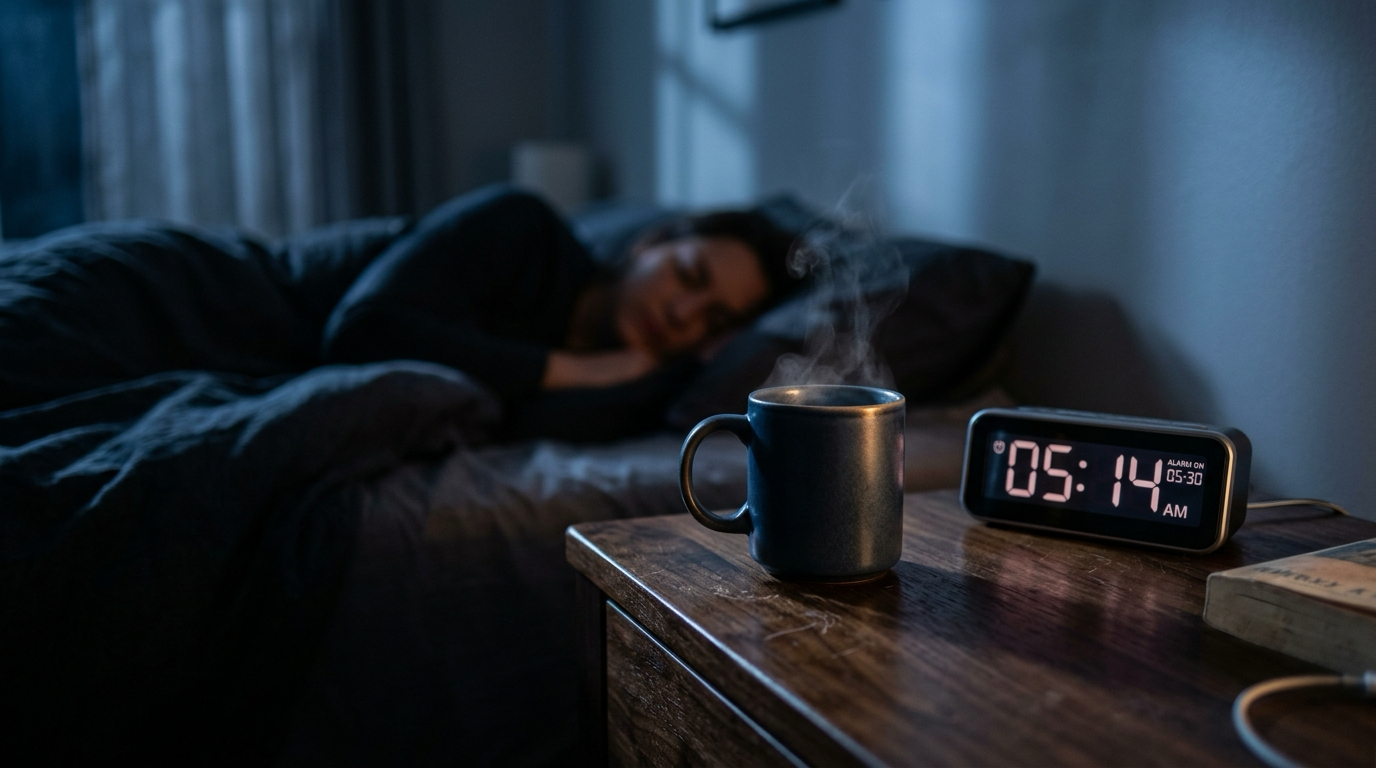
That afternoon coffee felt harmless. It was only 2 PM. You went to bed at 10:30 PM, fell asleep without much trouble, and still woke up feeling like you'd barely slept. No obvious reason. No stress, no screens in bed, no late-night snacking. Just... flat, groggy sleep that didn't do its job. If this sounds familiar, the answer may have been sitting in your mug eight hours earlier — and the math behind it is more unsettling than most people expect.
How Caffeine Hijacks Your Sleep Drive
To understand why caffeine disrupts sleep even when consumed hours before bedtime, you need to understand one chemical: adenosine.
Adenosine is a neurotransmitter that accumulates in your brain throughout the day. The longer you're awake, the more adenosine builds up, and the sleepier you feel. By the time you've been awake for 16 hours, adenosine levels are high enough to make you genuinely tired — this is your body's natural sleep drive, sometimes called "sleep pressure."
Caffeine doesn't give you energy. It doesn't add anything. What it does is block adenosine receptors, preventing adenosine from binding and delivering its sleepy signal. The adenosine is still accumulating — your body is still keeping score. But caffeine temporarily silences the alarm.
When the caffeine eventually clears from your system, all that accumulated adenosine floods its receptors at once. That's the "crash." And depending on when you had your last cup, some of that caffeine may still be blocking receptors when you try to fall asleep — even if you don't feel wired.
The Half-Life Equation Most People Get Wrong
Caffeine has a half-life of roughly 5 to 7 hours in the average adult. A half-life means that's how long it takes your body to eliminate half of the caffeine from your bloodstream. Not all of it. Half.
Run the math on a typical day:
- You drink a 200mg cup of coffee at 2:00 PM
- By 7:00 PM (5 hours later): ~100mg of caffeine remains in your system
- By midnight (5 more hours): ~50mg remains
- By 5:00 AM: ~25mg remains
That 25mg still circulating at 5 AM might not keep you awake, but here's what it does do: it continues to suppress the deep, slow-wave sleep stages your brain needs to repair and consolidate memory. You're asleep, but the sleep architecture is compromised.
Now consider what most people actually drink: a large coffee from a popular chain can hit 300–400mg per serving. Many people have two or three cups throughout the morning and afternoon. The cumulative caffeine load by evening can be substantial — even before they have that "one harmless cup" at 3 PM.
The Study That Should Change How You Schedule Coffee
The clearest evidence that "afternoon caffeine is fine" is a myth comes from a landmark study published in the Journal of Clinical Sleep Medicine in 2013. Researchers gave participants 400mg of caffeine at three different time points before bed: 6 hours, 3 hours, and immediately before.
The expected result was that caffeine consumed 6 hours before bed would cause minimal sleep disruption. The actual result: even the 6-hour-before dose reduced total sleep time by more than one hour and significantly worsened sleep quality as measured by polysomnography — objective sleep monitoring, not self-report.
Participants who took caffeine 6 hours before bed reported their sleep felt normal. The polysomnography said otherwise. Their deep sleep was reduced, their sleep was more fragmented, and their total sleep time was shorter — they just didn't consciously perceive it.
This is the quiet damage of afternoon caffeine. You feel like you slept. Your body knows you didn't.
Why Your Caffeine Cutoff Isn't the Same as Everyone Else's
Here's where caffeine gets genuinely complicated: genetics determine how fast you metabolize it, and there's a surprisingly wide range between individuals.
The primary enzyme responsible for breaking down caffeine in the liver is CYP1A2, and the gene that encodes it comes in two main variants. Fast metabolizers clear caffeine roughly twice as quickly as slow metabolizers. This isn't a minor difference — it's the difference between:
- A fast metabolizer who drinks coffee at 3 PM clearing most of it by 9 PM
- A slow metabolizer who drinks the same cup at 3 PM still having significant caffeine in their system at midnight
Slow metabolizers also carry higher cardiovascular risk from caffeine consumption, are more sensitive to its anxiety-inducing effects, and are more likely to experience nighttime waking even from moderate intake.
Several factors can make anyone metabolize caffeine more slowly than usual:
- Oral contraceptives — can double caffeine's half-life
- Pregnancy — half-life can extend to 15+ hours in the third trimester
- Liver disease or impaired liver function
- Certain medications — including some antibiotics, antidepressants, and blood pressure drugs
- Aging — metabolic rate slows with age
If you've ever thought "caffeine doesn't affect me, I can drink coffee at 9 PM and sleep fine," you may genuinely be a fast metabolizer. But if you think caffeine doesn't affect you because you fall asleep okay — that's worth reconsidering. Falling asleep is only one part of the picture.
The Morning Coffee Trap (It's Not Just About Bedtime)
There's a timing problem at the other end of the day too, and it's one that almost nobody talks about.
Cortisol — your body's primary alertness hormone — naturally peaks within 30 to 45 minutes of waking. During this cortisol surge, your body is already generating natural alertness. Drinking caffeine during this window doesn't add to that alertness — it largely competes with a system that's already doing its job, while simultaneously building tolerance faster and making you more caffeine-dependent.
Sleep researcher Andrew Huberman and others who study chronobiology suggest delaying caffeine intake until 90 to 120 minutes after waking to let your cortisol peak naturally. The practical payoff: coffee hits harder when you actually drink it, you need less of it overall, and the later your first cup, the earlier your last cup tends to fall — which moves it further from bedtime.
If your first coffee at 7 AM becomes your first coffee at 8:30 AM, that's not a small adjustment. It pulls your entire consumption window 90 minutes earlier — and at the other end of the day, 90 minutes matters.
If caffeine is covering up chronic fatigue, calculate the underlying deficit with the Sleep Debt Calculator before adding another afternoon cup.
The 7-Day Sleep Reset Protocol walks through a full caffeine timing framework alongside the other five levers that most directly impact sleep quality. If you've been treating sleep as a willpower problem, this reframes it as a systems problem — with specific daily adjustments.
Get the Sleep Reset Protocol — $17 →
What Caffeine Does to Your Sleep Architecture
Even when caffeine doesn't prevent you from falling asleep, it changes what kind of sleep you get. The sleep stages most affected:
Slow-wave sleep (SWS) / Deep sleep: This is the most physically restorative stage — the one where growth hormone is released, cells repair, and the immune system consolidates. Multiple studies have shown that moderate caffeine consumption reduces slow-wave sleep by 20% or more, even when consumed in the early afternoon.
REM sleep: The stage most associated with emotional processing, memory consolidation, and creativity. Caffeine has a more variable effect on REM, but late or high doses tend to delay or reduce REM in the first half of the night.
The net result: you may log 7.5 hours on your tracker, but the composition of those hours is shifted away from the most valuable stages. This is why people who cut caffeine after noon often report that their sleep feels "different" within just a few days — not longer, necessarily, but deeper and more restorative.
Signs Caffeine May Be Affecting Your Sleep More Than You Think
Most people connect caffeine to trouble falling asleep. But the subtler signs are more common:
- Waking between 2–4 AM — caffeine's stimulant effect can fragment sleep in the middle of the night, particularly if adenosine rebounds
- Needing caffeine to function in the morning — a sign of accumulated sleep debt or high caffeine dependency from suppressed adenosine
- Sleep that doesn't feel restorative despite adequate hours
- Vivid or anxious dreams — shallow sleep produces more memorable dreaming
- Tension headaches in the morning — can signal overnight caffeine withdrawal, which confirms dependency has set in
- Afternoon energy crashes that require more caffeine — the cycle feeding on itself
Your Personal Caffeine Cutoff: A Practical Framework
Rather than a universal "no caffeine after 2 PM" rule, a more accurate formula accounts for your individual half-life:
Rough personal cutoff = Bedtime − (2 × caffeine half-life)
For an average adult with a 6-hour half-life targeting 10 PM bedtime: 10 PM − 12 hours = 10 AM cutoff
That feels aggressive — and for many people it is. A more forgiving version that still reduces sleep impact meaningfully:
- Conservative: Last caffeine 8–10 hours before bedtime
- Moderate: Last caffeine 6 hours before bedtime (still carries risk per the Drake study)
- Experimental: Track your sleep quality for 2 weeks after moving your cutoff 2 hours earlier — most people notice a difference within 5–7 days
The quantity matters as much as the timing. 400mg consumed by noon creates a heavier load at any hour than 100mg consumed at 2 PM.
How to Support Sleep When You're Cutting Back on Caffeine
The first week of shifting your caffeine window earlier often feels rough — not because caffeine was the only thing keeping you alert, but because your sleep debt was real and caffeine had been masking it. A few things that help during the transition:
Magnesium glycinate is one of the better-researched supplements for sleep quality, specifically for its role in regulating GABA — the primary inhibitory neurotransmitter that promotes relaxation and sleep. Unlike magnesium oxide (which is mostly used as a laxative), glycinate form is highly absorbable and notably gentle on digestion. 300–400mg taken 30–60 minutes before bed works well for most people. Doctor's Best High Absorption Magnesium Glycinate is a reliable, well-formulated option that's been around for years.
L-theanine, an amino acid found naturally in green tea, blunts caffeine's anxiogenic (anxiety-producing) effects when taken together with it — and also supports relaxation in the evening without causing drowsiness the way melatonin can. If you're in the habit of drinking tea rather than quitting caffeine entirely, switching to green tea from coffee gives you lower caffeine content with L-theanine naturally present.
Anchor your sleep schedule. Caffeine disrupts sleep partly by delaying your circadian rhythm. The fastest correction is a fixed wake time — even on weekends — that trains your body to anticipate sleep at the same time each night. The consistency makes the adenosine system more predictable and reduces your reliance on caffeine to get through the morning.
Protect your sleep environment. One often-overlooked factor is that caffeine-disrupted sleep is lighter sleep — and lighter sleep means you're more sensitive to noise and temperature fluctuations. A cooling mattress pad, quality earplugs, or a white noise machine becomes more impactful when you're working to recover sleep quality rather than just sleep quantity.
The Two-Week Test Worth Running
If you want actual data on how caffeine is affecting your sleep, run this experiment: move your last caffeine intake 2 hours earlier than your current norm, hold it for 14 days, and pay attention to four things — how you feel upon waking, whether you wake in the middle of the night, how quickly you fall asleep, and your general afternoon energy level (without caffeine compensation).
Most people who run this test are surprised. Not because they couldn't sleep before, but because they discover what their sleep actually feels like without caffeine's interference — and realize they'd been living with a baseline that was lower than it needed to be.
The goal isn't to quit caffeine. It's to stop letting a 2 PM latte undo what an 11 PM bedtime was supposed to do.
Frequently Asked Questions
How long before bed should I stop drinking caffeine?+
For most people, cutting caffeine 8–10 hours before bedtime is the conservative target. With caffeine's average 5–7 hour half-life, a 2 PM cup still has significant caffeine active at midnight. If you target 10 PM bedtime, your last caffeine should ideally be by noon or 1 PM.
Can caffeine affect sleep even if I fall asleep fine?+
Yes — this is the most commonly missed effect. Caffeine can reduce slow-wave (deep) sleep by 20% or more even when it does not prevent sleep onset. You may log 7–8 hours but wake up feeling flat because your sleep architecture was compromised, not your total sleep time.
What is caffeine's half-life and why does it matter?+
Caffeine's half-life is roughly 5 to 7 hours in the average adult — meaning half of a 200mg dose is still in your system 5–7 hours later. Genetics, age, medications like oral contraceptives, and liver function all influence how fast you clear it. Slow metabolizers can have a half-life of 9–12 hours.
Why do I wake up at 2–4 AM even though caffeine isn't keeping me awake?+
Caffeine can fragment sleep in the middle of the night by suppressing adenosine during the first part of sleep, then allowing an adenosine rebound in the early morning hours. This rebound, combined with lighter sleep stages caused by caffeine, makes middle-of-night waking more likely.
What supplements help support sleep quality when reducing caffeine?+
Magnesium glycinate (300–400mg before bed) is well-researched for supporting slow-wave sleep and GABA function. L-theanine supports relaxation without drowsiness and pairs well with green tea as a lower-caffeine alternative to coffee. Neither replaces proper caffeine timing but both support the transition period.
Keep Reading
Sleep Smarter Editorial Team
Our editorial team researches and writes evidence-based sleep content grounded in peer-reviewed science. All articles reference established sleep research from sources including the NIH, AASM, and Sleep Foundation.