Best Pillows for Sleep by Sleep Position: A Science-Backed Guide
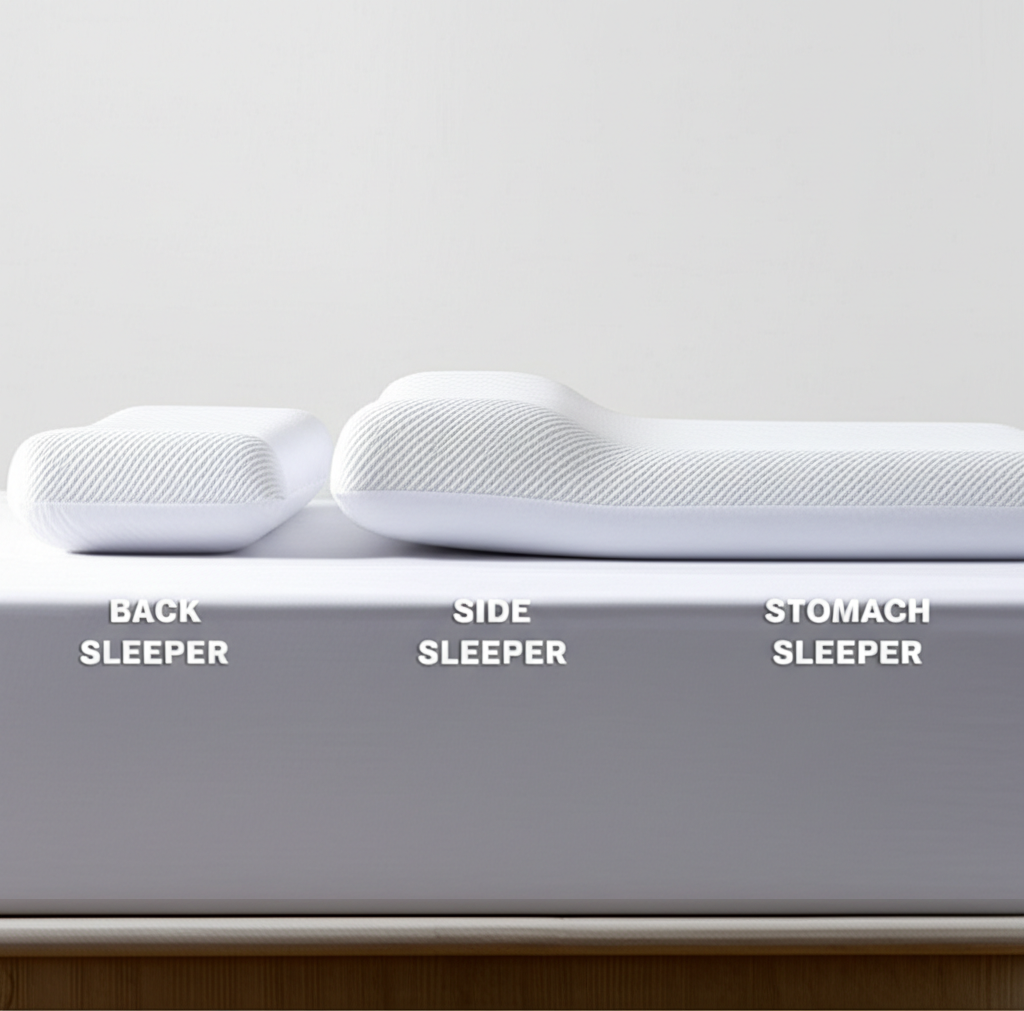
The Pillow Problem Nobody Talks About
You upgraded your mattress. Your sleep improved — a little. But you're still waking up with a stiff neck. Still adjusting your pillow at 2 AM. Still not quite right.
The culprit is almost certainly your pillow.
Most people choose a pillow based on feel in the store — squeezing it for five seconds and deciding it's "comfortable." That's like choosing a mattress by how it looks. The feel at the store has almost nothing to do with how it performs after 7 hours in your specific sleep position.
Here's the problem: your pillow is doing structural work. It's maintaining the alignment of your cervical spine (the seven vertebrae in your neck) while the rest of your spine is supported by your mattress. Get that height — called loft — wrong by even an inch, and your neck spends the night in extension or flexion. After 300+ nights a year, that adds up.
A 2019 review in the Journal of Pain Research found that pillow type and loft were directly associated with cervical spine pain upon waking. The fix isn't expensive — it's specific.
This guide gives you the science, then gives you the answer for your position.
The Science: What Your Pillow Is Actually Doing
Cervical Spine Alignment 101
Your cervical spine has a natural lordotic curve — a slight forward curve when viewed from the side. In your ideal sleeping posture, that curve is maintained in a neutral position: not hyperextended (chin jutting up) and not flexed (chin tucked to chest).
The job of your pillow is to fill the gap between your head and the mattress — that gap changes significantly based on your sleep position.
The key variables:
| Variable | What It Means | Why It Matters |
|---|---|---|
| Loft (height) | How thick the pillow is | Determines neck angle |
| Firmness | How much it compresses under pressure | Affects how loft changes during sleep |
| Contour | Shaped vs. uniform fill | Can support cervical curve specifically |
| Material | Memory foam, latex, down, etc. | Affects pressure distribution, temperature, durability |
How Firmness Changes Loft
This is where most buyers get confused. A "medium" pillow that's 5 inches tall might actually perform like a 3-inch pillow after your head compresses it. A firm pillow at 4 inches might maintain 3.5 inches under load.
What matters isn't the stated loft — it's the compressed loft under the weight of your head (~10-12 lbs for adults).
This is why adjustable pillows — those with removable fill — have become popular. You dial in the compressed loft to your specific gap, rather than guessing.
Temperature & Material Considerations
Pillow fill also affects sleep temperature, which matters more than most people realize. As we covered in our sleep temperature optimization guide, your core body temperature needs to drop 2-3°F to initiate and maintain sleep. Dense memory foam pillows trap heat at the neck and head — an area with significant blood vessels — potentially disrupting this process.
Material temperature profiles:
- Traditional memory foam: Warmest (traps heat)
- Gel-infused memory foam: Moderate (dissipates some heat)
- Latex: Naturally breathable, runs cooler than foam
- Down/alternative down: Breathable, moderate temperature
- Buckwheat: Coolest (excellent airflow)
- Hybrid (foam + grid): Cool (active airflow channels)
By Sleep Position: What You Actually Need
Back Sleepers
The goal: Maintain the cervical lordotic curve without pushing the head too far forward or letting it fall back.
Back sleepers need a medium loft, medium firmness pillow — typically 3–5 inches of compressed height. Too high pushes the chin toward the chest (flexion). Too low lets the head fall back (extension).
What to look for:
- Contoured or cervical pillows (ergonomic shape) work particularly well here
- Medium density memory foam or latex
- Avoid overstuffed down pillows — they compress unevenly and create a "hill" effect
What to avoid:
- High-loft pillows designed for side sleepers
- Extremely firm pillows that push the head up
- Thin, flat pillows that drop the head below mattress level
Quick test: Lie on your back on your mattress. Have someone look from the side. Your chin should be level — not angled toward your chest or ceiling.
Side Sleepers
Side sleepers have the largest gap to fill — from the mattress surface to the side of their head. That distance is roughly equal to your shoulder width, which varies by body size but averages 4–6 inches for most adults.
This is the position that demands the most from a pillow. Insufficient loft means the upper shoulder collapses inward. Too much loft tilts the head upward, creating lateral cervical strain.
What to look for:
- High loft: 4–6 inches compressed
- Firm support that doesn't collapse under the weight of your head
- Consistent support across the entire surface (avoid pillows that shift fill to one side)
- Wide profile to support head and upper neck
What to avoid:
- Soft down pillows that bottom out overnight
- Standard height pillows designed for back sleepers
- Asymmetrical fill distribution
Note for shoulder width: Broader-shouldered individuals typically need more loft than narrower-shouldered ones. Adjustable pillows are excellent for side sleepers for this reason.
Stomach Sleepers
Sleep medicine researchers have mixed views on stomach sleeping — it places the cervical spine in rotation for hours at a time. The research suggests it's the least biomechanically optimal position (Cary et al., 2016, BMC Musculoskeletal Disorders).
That said, it's a deeply ingrained habit for many people, and the right pillow can minimize the strain.
The goal: Get the head as close to mattress level as possible to reduce cervical rotation.
What to look for:
- Very low loft (1–3 inches, or no pillow at all for some)
- Very soft fill that compresses easily
- Thin, flat design
- Some stomach sleepers do better with a pillow under the pelvis (not the head) to reduce lower back arch
What to avoid:
- Any high-loft pillow — this is the worst mismatch possible for stomach sleepers
- Firm memory foam or latex (maintains loft under pressure)
- Cervical contour pillows (designed for back sleepers, wrong shape)
Combination Sleepers
If you shift positions through the night — the majority of adults do — you need a pillow that performs acceptably in multiple positions.
The strategy: Optimize for your primary position, but choose a material and shape that isn't catastrophic in secondary positions.
Best approaches:
- Adjustable shredded foam: Medium loft works passably for back and side; push fill to one end for height variation
- Medium-loft latex: Responsive and bouncy — adjusts faster than memory foam as you shift
- Avoid: Fixed-shape contour pillows designed specifically for one position
Product Recommendations
These recommendations are based on fill type, loft, and the specific alignment needs of each sleep position. Prices and availability are subject to change.
🥇 Best for Side Sleepers — Coop Home Goods Eden Pillow
Why it works: Shredded memory foam + microfiber fill that's fully adjustable. You remove or add fill until the compressed loft matches your shoulder width exactly. Most people find medium-to-full fill optimal. GREENGUARD Gold certified, meaning low VOC emissions.
- Loft: Adjustable (medium to high)
- Firmness: Medium (adjustable)
- Material: Shredded memory foam + microfiber, bamboo-derived cover
- Best for: Side sleepers, combination sleepers
🥇 Best for Combination Sleepers — Purple Harmony Pillow
Why it works: A Talalay latex core surrounded by Purple's hexagonal GelFlex grid. The grid creates pressure-responsive support — it collapses under direct pressure (your head) while remaining firm around the edges. Responds immediately as you shift positions, unlike memory foam which has a slow recovery. Naturally breathable, runs cool.
- Loft: Medium (standard) or tall (larger frames/side sleepers)
- Firmness: Medium
- Material: Talalay latex + GelFlex grid, no memory foam
- Best for: Combination sleepers, hot sleepers, side and back
🥇 Best for Back Sleepers — Tempur-Pedic TEMPUR-Cloud Pillow
Why it works: TEMPUR material conforms to the natural curve of the cervical spine and stays put — no shifting or bunching. Medium loft is well-suited for back sleepers. Slower response time than latex (not ideal for combination sleepers) but excellent for dedicated back sleepers who want precise, consistent support all night.
- Loft: Medium
- Firmness: Medium-soft
- Material: TEMPUR foam (proprietary viscoelastic)
- Best for: Back sleepers, those with cervical sensitivity
🥇 Best for Stomach Sleepers — Casper Sleep Original Pillow
Why it works: Down-alternative fill with medium-soft loft that compresses easily under the weight of a stomach sleeper's head. The fill redistributes naturally, allowing the head to rest close to mattress level without complete pillow collapse. Machine washable.
- Loft: Medium (compresses to low under pressure)
- Firmness: Medium-soft
- Material: Down alternative (microfiber)
- Best for: Stomach sleepers, those who prefer a traditional pillow feel
🥇 Best for Side Sleepers (High Profile) — Tempur-Pedic TEMPUR-Cloud ProHi
Why it works: High-profile design built specifically for side sleepers and larger frames. The elevated loft fills the shoulder-to-head gap without requiring any DIY adjustment. TEMPUR material provides consistent support throughout the night.
- Loft: High
- Firmness: Medium
- Material: TEMPUR foam + micro-cushions
- Best for: Side sleepers, broad-shouldered individuals
Pillow Buying Checklist
Use this before you order:
- Identify your primary sleep position — back, side, stomach, or combo
- Estimate your shoulder width (side sleepers) — broader = higher loft needed
- Consider your mattress firmness — softer mattresses let shoulders sink in more, reducing the gap; this means side sleepers on soft mattresses may need slightly lower loft
- Assess your temperature sensitivity — hot sleepers should avoid traditional memory foam; look for latex, hybrid grid, or breathable fill
- Check certifications — CertiPUR-US (foams), OEKO-TEX, or GREENGUARD Gold indicate low chemical emissions
- Consider adjustability — if you're unsure of your ideal loft, start with an adjustable option (Coop Eden is the standard recommendation)
- Check the return policy — most quality pillow brands offer 30–100 night trials; use them
- Note your current pillow's failings — is your neck stiff in the morning? Head too high or too low? This diagnostic is your starting point
Frequently Asked Questions
What pillow height is best for back sleepers?+
Back sleepers need a pillow with 3-5 inches of loft (compressed) to maintain the natural cervical curve. Too high pushes the head forward; too flat lets it fall back. Medium-loft memory foam or latex works well.
Do side sleepers need a firmer pillow?+
Yes — side sleepers need a firmer, higher-loft pillow (4-6 inches) to bridge the gap between shoulder and head. Without adequate loft and firmness, the head drops and the neck bends laterally for hours.
What pillow is best for stomach sleepers?+
Stomach sleepers need the thinnest, softest pillow available — or no pillow at all. Thick pillows force the neck into extreme extension overnight, causing stiffness and pain. A pillow under the pelvis can also help alignment.
How often should you replace your pillow?+
Most pillows should be replaced every 1-2 years. Memory foam and latex last longer (2-3 years). A simple test: fold your pillow in half — if it stays folded instead of springing back, it's lost its support and needs replacing.
Keep Reading
Sleep Smarter Editorial Team
Our editorial team researches and writes evidence-based sleep content grounded in peer-reviewed science. All articles reference established sleep research from sources including the NIH, AASM, and Sleep Foundation.