Sleep-Onset Anxiety: Why Your Brain Activates at Bedtime
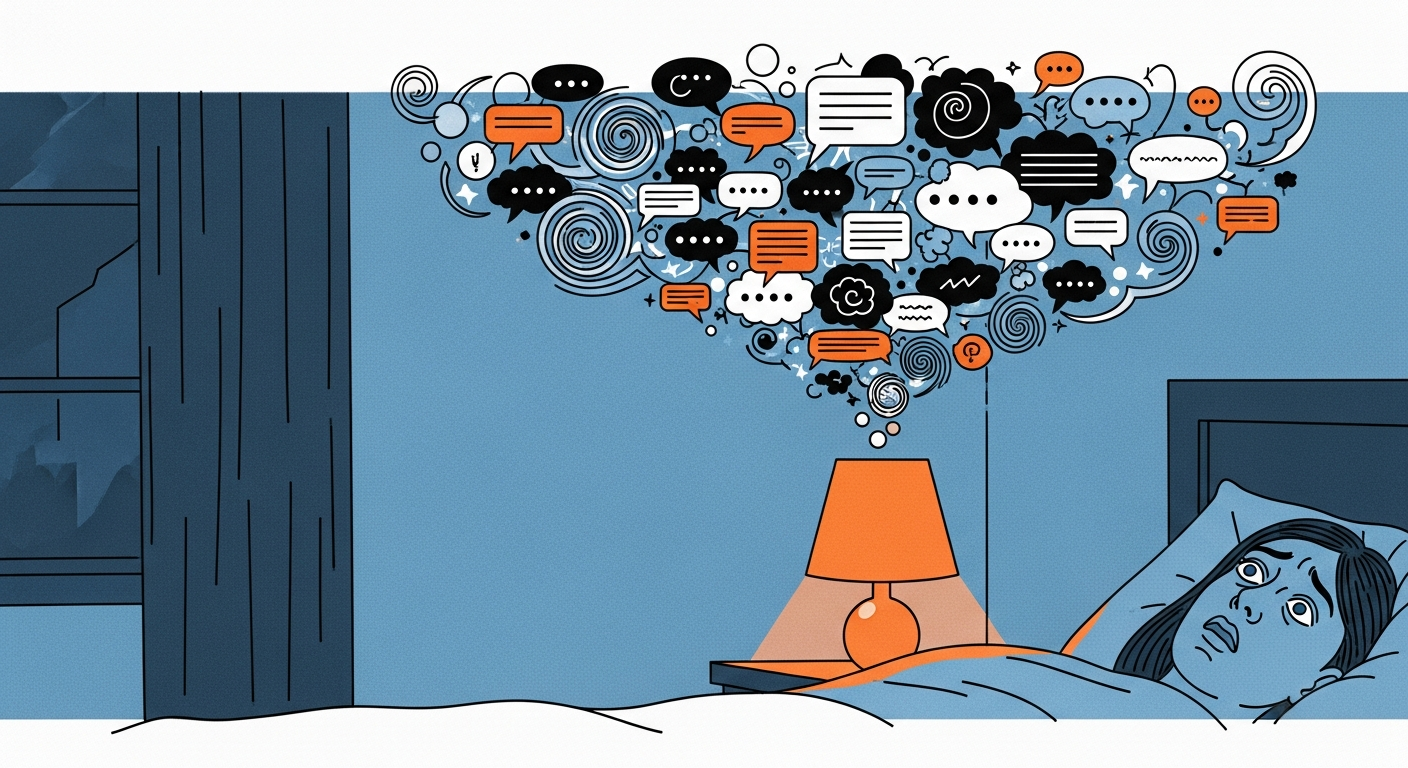
You finally hit the pillow. You're exhausted — you've been yawning since 9 PM. And the moment your head makes contact, something strange happens: your brain turns on. That conversation from three days ago. A work deadline. A vague sense of dread you can't name. The thoughts arrive fast, then faster, and suddenly sleep feels further away than it did an hour ago.
This isn't a willpower problem. It's a neurological one — and understanding exactly why it happens is the first step to stopping it.
What Sleep-Onset Anxiety Actually Is (And Why It's Not What You Think)
Most people assume they can't sleep because they're stressed. That's partially true, but it misses the mechanism. Sleep-onset anxiety — the brain activation that occurs specifically when you attempt to fall asleep — is driven by a predictable neurological sequence that has nothing to do with how stressed you are overall.
Here's what's actually happening:
When your environment quiets and external stimulation drops, your brain shifts into what neuroscientists call the default mode network (DMN) — a cluster of brain regions including the medial prefrontal cortex and posterior cingulate cortex that activates when you're not focused on an external task. The DMN is where self-referential thinking lives: rumination, worry, hypothetical scenarios, replaying social interactions.
During the day, your DMN is kept in check by task-positive networks — the parts of the brain engaged in work, conversation, and stimulation. When you lie down and remove all that task input? The DMN surges. And if your brain has learned to associate bedtime with anxiety (even mildly), it starts treating the transition to sleep as a threat state — triggering a mild release of cortisol and norepinephrine that creates genuine physiological arousal. Heart rate ticks up. Muscle tension increases. Mental activity accelerates.
You're not imagining it. Your nervous system is literally working against sleep.
The Hyperarousal Loop (Why It Gets Worse Over Time)
Sleep-onset anxiety tends to compound. Researchers call this conditioned arousal — a process where the bed itself becomes a cue for wakefulness rather than sleep.
The loop works like this:
- You have a few nights of lying awake, anxious
- Your brain learns: bed = alertness/anxiety
- You approach bedtime with anticipatory anxiety ("I probably won't be able to sleep again")
- That anticipatory anxiety activates the stress response before you even lie down
- You lie down and the hyperarousal is already running
- Sleep gets harder → loop tightens
This is why people sometimes sleep better in hotels or at a friend's house. Remove the conditioned cue (your bed, your bedroom), and the loop breaks temporarily. Your brain hasn't learned to be anxious there yet.
Understanding this loop explains why most generic sleep advice fails. Telling an anxious brain to "relax" is like telling someone mid-sprint to stop running. The arousal is already biochemically underway. What you need are techniques that work with the nervous system's actual mechanisms — not against them.
7 Evidence-Based Interventions That Work
1. Scheduled Worry Time (Move Anxiety Out of Bed)
This technique comes directly out of clinical Cognitive Behavioral Therapy for Insomnia (CBT-I) and has the strongest research base of any behavioral sleep intervention. The concept: your brain has legitimate concerns it wants to process. Rather than suppressing them, you give them a designated window — just not at bedtime.
Set a 15-minute "worry window" for 2-3 hours before bed. Write down everything on your mind: concerns, to-do items, unresolved situations. Once written, they're captured. The brain is remarkably good at releasing what it knows is externally stored.
Penn State research found that people who journaled their worries fell asleep an average of 15 minutes faster than controls. The key is writing tasks (what you'll do tomorrow) rather than problems (what might go wrong). Forward-looking specificity is what quiets the brain.
2. Progressive Muscle Relaxation Targeting Counterintuitive Spots
Progressive muscle relaxation (PMR) is well-established, but most people do it wrong for sleep anxiety. They start at the feet and work up — which means the face, jaw, and neck (the areas where anxiety lives) come last, when attention is already drifting.
Reverse it. Start with: jaw → shoulders → hands → feet. The jaw in particular is a massive arousal signal. Most people with sleep anxiety have chronic jaw tension they don't notice until they deliberately release it. Clench for 7 seconds, release, hold for 20. The contrast between tension and release activates the parasympathetic nervous system more effectively than just "trying to relax."
3. The 4-7-8 Breathing Protocol (With a Critical Modification)
The 4-7-8 breath (inhale 4 counts, hold 7, exhale 8) works by extending the exhale, which activates the vagus nerve and shifts the autonomic nervous system toward parasympathetic dominance. The problem: many anxious sleepers find the breath-hold on a 7 count increases anxiety, especially early on.
The modification: drop to a 4-4-6 pattern (inhale 4, hold 4, exhale 6) until the technique feels comfortable — usually after a week of practice. The extended exhale is the active ingredient. The ratio matters less than the principle: exhale longer than inhale, and do it through the nose.
Pair this with a hand on the chest and a hand on the belly. Belly should rise first. Chest breathing during anxiety is a feedback loop — it signals the body to stay in fight-or-flight.
4. Cognitive Defusion: Rename the Thoughts
CBT-I research distinguishes between thought suppression (terrible for sleep anxiety) and cognitive defusion (effective). Suppression — trying not to think about something — paradoxically increases the thought's salience. The white bear problem: try not to think about a white bear, and that's all you can think about.
Defusion creates distance without suppression. Instead of "I'm going to be exhausted tomorrow," try: "I'm having the thought that I'll be exhausted tomorrow." Add one more layer: "My brain is generating the thought that I'll be exhausted tomorrow."
It sounds minor, but the effect is real. You're activating the prefrontal cortex's labeling function, which reduces amygdala activation. You're observing the thought rather than fusing with it — and anxious thoughts have much less power as observations than they do as reality.
5. Temperature as a Biological Signal
Core body temperature drop is one of the primary triggers for sleep onset. When your bedroom or bedding is too warm, you're literally working against the body's sleep initiation mechanism. But for sleep-onset anxiety specifically, strategic cooling can serve as an active intervention.
Cold water on the face (or a cool, damp cloth on the forehead) activates the diving reflex — a powerful parasympathetic response that immediately lowers heart rate. Even 30 seconds of cool water on the face can interrupt the cortisol-norepinephrine loop of nighttime hyperarousal. Some people find this more effective than any breathing technique because it bypasses cognitive processes entirely — it's a direct vagal nerve trigger.
On the bedding side, temperature regulation during the night matters too. Overheating during sleep, even mildly, increases micro-arousals and fragments the deeper sleep stages where anxiety gets neurologically processed. A temperature-regulating comforter→ can make a meaningful difference — particularly if you run warm or wake up having kicked off the covers. Promeed's CoolRest comforter is specifically designed for this: it dissipates heat rather than trapping it, keeping you in the temperature window where deep sleep happens.
6. The Stimulus Control Protocol
This is one of the most well-replicated findings in sleep medicine: for sleep-onset anxiety, the bed needs to be only for sleep. Stimulus control therapy works by reversing the conditioned arousal loop.
The rules are strict but temporary:
- If you haven't fallen asleep within ~20 minutes, get out of bed
- Go to a dim, quiet room and do something low-stimulation (not a screen)
- Return only when you feel genuinely sleepy (not just tired)
- Repeat as needed — even if it means multiple trips the first few nights
The goal isn't to tire yourself out. It's to break the association between your bed and wakefulness. This feels counterintuitive — especially if you're exhausted. But the research is clear: people who follow stimulus control see measurable improvement in sleep-onset latency within 1-2 weeks, without medication.
7. Pre-Sleep Sensory Grounding
Anxiety lives in the future. Grounding techniques pull attention back to present-tense sensory experience — which is incompatible with the hypothetical rumination that drives sleep-onset anxiety.
The 5-4-3-2-1 technique is well-known but works better with a sleep-specific modification. Instead of visually cataloging the room, close your eyes and focus exclusively on:
- 5 physical sensations you can feel right now: the weight of the blanket, the temperature of the pillow, the feel of fabric on your legs, the pressure of the mattress at your back, the air in your nostrils
- 4 sounds you can hear: however faint — the hum of an HVAC unit, traffic, silence between sounds
- 3 body parts you can soften right now without effort: the back of the tongue, the space between the eyebrows, the hands
The pillow contact point is worth lingering on. If your pillow is creating sensory friction — too warm, too rough, or pulling at hair — it keeps the nervous system in a subtle state of alertness. Materials like Promeed's Luxgen silk pillowcase→ reduce that surface friction and temperature retention, creating a more neutral sensory input that the grounding exercise can actually work with. It's a small detail that compounds over time.
The Bigger Picture: Anxiety Is a Sleep System Problem
Sleep-onset anxiety rarely exists in a vacuum. It's almost always accompanied by other sleep quality issues — fragmented sleep, non-restorative rest, morning grogginess despite hours in bed. The anxiety is often a symptom of a dysregulated sleep system rather than just a psychological issue to be managed.
If you've been dealing with sleep-onset anxiety for more than a few weeks, the most effective intervention is a structured protocol that addresses the full system: sleep timing, stimulus control, cognitive patterns, and environmental setup together.
Ready to reset your sleep system from the ground up? The 7-Day Sleep Reset Protocol walks you through exactly this — a day-by-day plan built on the same CBT-I research framework used by clinical sleep psychologists, adapted for people who don't have time for a 12-week therapy program. $17. 60-day guarantee. Starts the night you get it.
Frequently Asked Questions
Is sleep-onset anxiety the same as insomnia?+
Not exactly. Insomnia is a broader category (difficulty falling or staying asleep), while sleep-onset anxiety is a specific cause of insomnia. You can have sleep-onset anxiety without clinical insomnia, and vice versa.
Can medication help with sleep-onset anxiety?+
Short-term, yes — benzodiazepines or sleep aids can suppress anxiety temporarily. However, research shows behavioral interventions are more effective long-term because they address the root cause. Medication is best used alongside behavioral therapy, not as a replacement.
How long does it take for these techniques to work?+
Most people notice improvement within 3-7 nights of consistent practice. The 4-7-8 breathing and mental dump often work on the first night. Sleep restriction therapy typically takes 2-3 weeks to show full effects.
Why does telling myself "don't think about it" make it worse?+
This is the "ironic rebound effect." When you try to suppress a thought, your brain becomes more attuned to it — like trying not to think about a white elephant. Cognitive defusion (noticing the thought without fighting it) works better.
Can sleep-onset anxiety develop suddenly?+
Yes. Major life stress, health changes, or even a single bad night of sleep can trigger it. Once it starts, anticipatory anxiety often keeps it going. The good news is that interventions work quickly once you break the cycle.
Keep Reading
Sleep Smarter Editorial Team
Our editorial team researches and writes evidence-based sleep content grounded in peer-reviewed science. All articles reference established sleep research from sources including the NIH, AASM, and Sleep Foundation.