Anxiety Waves When Falling Asleep: Why It Happens and How to Stop It
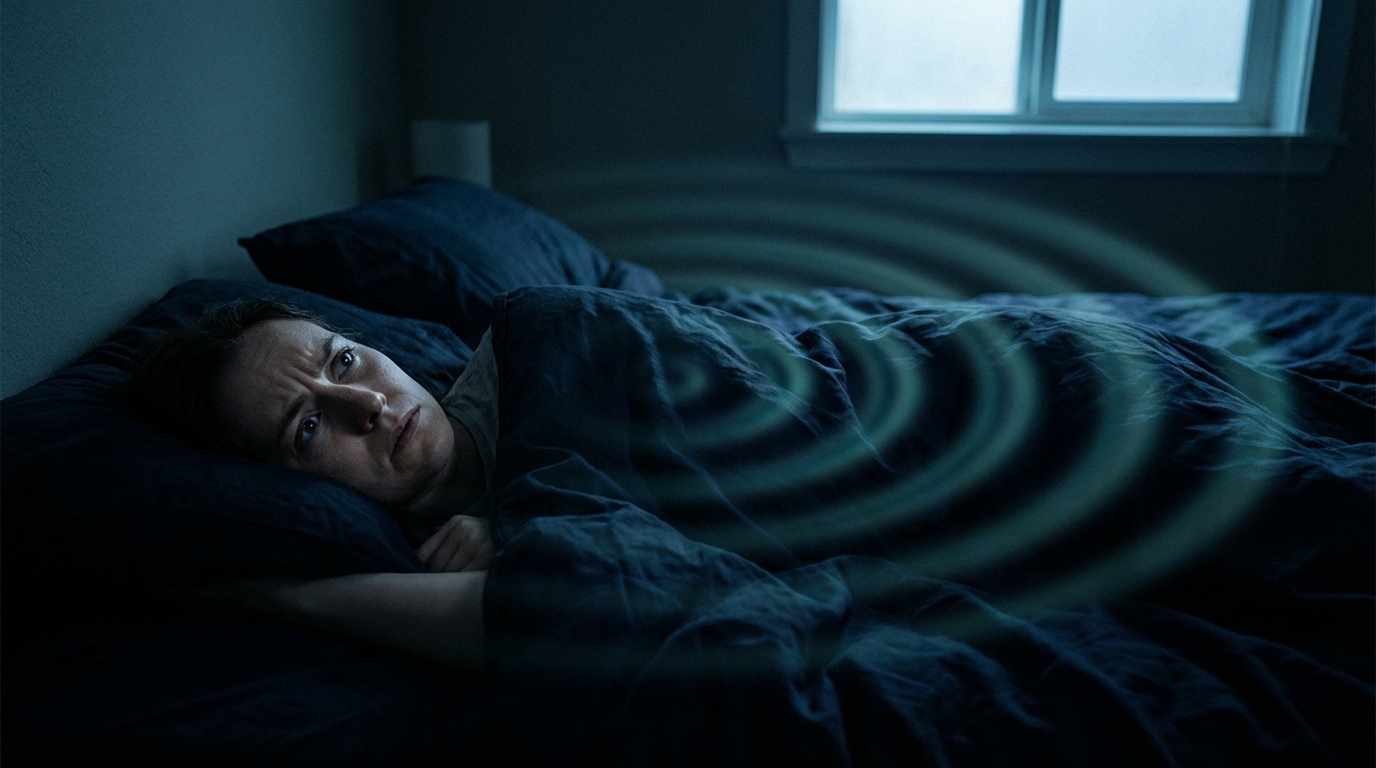
You're finally in bed. You've been exhausted for hours. Your eyes close, your breathing slows — and then it hits. A sudden wave of unease floods through your chest. Your heart lurches. Your body jolts awake. The feeling is hard to describe: somewhere between butterflies, a silent alarm, and the sensation of tipping off a ledge. And then it fades, you drift again, and it happens again.
If you've experienced this, you've probably typed some version of "why do I feel anxious when falling asleep" into Google at 1 AM — and found nothing that quite described what you were feeling. You're not imagining it. You're not broken. There's a name for it, a mechanism behind it, and — more importantly — a way to make it stop.
What Are These "Anxiety Waves," Exactly?
The sensation most people describe — an abrupt wave of dread or unease right at the edge of sleep — doesn't have a single clinical name, which is part of why it's so disorienting. It typically involves one or more of the following:
- A sudden rush of anxious feeling in the chest or stomach
- Heart pounding or skipping a beat as you drift off
- A physical jolt that snaps you awake (sometimes called a hypnic jerk)
- A vague sense of doom or danger with no identifiable source
- The cycle repeating: drift, jolt, drift, jolt
These experiences are distinct from general bedtime worry (the racing thoughts kind). The anxiety wave hits at the physiological moment of sleep onset — not before it. That timing matters, because it points directly to the mechanism.
The Science: Your Nervous System Is Staging a Mutiny
Here's what's happening under the hood.
As you cross the threshold from wakefulness into sleep, your brain initiates a dramatic transition. The prefrontal cortex — the region responsible for rational thought and executive control — begins powering down. Heart rate and breathing slow. Your sympathetic nervous system (the "fight or flight" system) is supposed to hand the baton to the parasympathetic nervous system (the "rest and digest" system).
In healthy sleepers, this handoff is seamless. But if your nervous system is running in a chronic state of high alert — from stress, anxiety, disrupted sleep patterns, or even caffeine — that transition can misfire.
Your brain, mid-handoff, briefly interprets the loss of conscious control as a threat. The sympathetic system re-engages. Cortisol and adrenaline pulse through your body. Your heart rate spikes. You startle awake with that characteristic wave of dread.
It's not psychological weakness. It's your nervous system doing exactly what it's designed to do — protect you from perceived danger. The problem is that "I'm about to fall asleep" has been misclassified as dangerous.
Researchers studying this phenomenon have found that people with anxiety disorders or chronic insomnia show measurably higher heart rate variability fluctuations at sleep onset, and elevated arousal markers during the N1 sleep stage — the first stage of sleep, when you're most vulnerable to these waves. The sleep-onset period, rather than being a neutral transition, becomes a trigger zone.
Hypnic Jerks vs. Sleep Anxiety Waves: Not the Same Thing
It's worth separating two overlapping but distinct phenomena here.
Hypnic jerks (also called hypnagogic jerks or sleep starts) are the involuntary muscle contractions that jolt you awake when you're falling asleep. These are almost universally experienced — studies suggest up to 70% of people experience them. They're often benign, linked to the brain misinterpreting the muscle relaxation of sleep onset as "falling." They become more frequent when you're sleep-deprived, stressed, or have consumed caffeine.
Sleep onset anxiety waves are different. These are primarily emotional and autonomic — the sudden rush of fear or dread, the pounding heart, the free-floating unease. They may or may not accompany a physical jolt. Many people report one without the other.
Both can happen together and reinforce each other. A hypnic jerk can trigger anxiety about sleeping; that anxiety raises cortisol; elevated cortisol increases the likelihood of another jolt. The loop is physiological and psychological simultaneously.
The Cortisol Timing Problem
Cortisol — your body's primary stress hormone — follows a precise daily rhythm. It should peak in the morning (helping you wake up and feel alert) and reach its lowest point in the late evening and first half of the night (enabling deep sleep).
The problem for many people is cortisol timing disruption. Evening stress, blue light exposure, alcohol, intense exercise, or simply a chronically activated nervous system can keep cortisol elevated past its natural evening drop. When cortisol is still circulating at elevated levels as you're trying to fall asleep, your body is essentially receiving a "stay alert" signal at the exact moment it needs to shut down.
Research published in the journal Psychoneuroendocrinology found that people with higher evening cortisol levels had significantly more fragmented sleep-onset experiences and more frequent nocturnal awakenings. The wave you feel isn't random — it's often a cortisol pulse riding against the grain of your intended sleep window.
5 Evidence-Based Ways to Stop the Waves
1. Magnesium Glycinate in the Evening
Magnesium glycinate has the best evidence base of any over-the-counter supplement for calming sleep onset arousal. Magnesium directly modulates GABA receptors — the same receptors targeted by anti-anxiety medications — and helps regulate the HPA axis response (the cortisol production system). The glycinate form is chelated, which means superior absorption and gentler on the gut than oxide or citrate forms.
A 2012 randomized controlled trial found that magnesium supplementation significantly reduced nighttime cortisol levels and improved subjective sleep quality in older adults. The effect is subtle for mild cases and more pronounced for people who are actually deficient — which, given that surveys estimate 48–68% of Americans don't meet daily magnesium requirements, is a lot of people.
Dose: 200–400mg of magnesium glycinate, taken 30–60 minutes before bed. Don't expect miracles on night one — effects build over 1–2 weeks of consistent use.
2. Physiological Sigh (The Fastest Nervous System Reset)
Stanford neuroscientist Andrew Huberman has popularized research on the physiological sigh as the fastest way to downregulate sympathetic nervous system activation. The technique: two short inhales through the nose (the second inhale forcefully tops off the lungs), followed by one long, slow exhale through the mouth.
The double inhale fully reinflates alveolar sacs in the lungs that partially collapse during relaxed breathing. The extended exhale activates the vagus nerve and the parasympathetic system. In controlled studies, a single physiological sigh produced measurably faster heart rate deceleration than standard slow breathing protocols.
Do this the moment you feel a wave starting, rather than fighting it or bracing against it. Three to five rounds is usually enough to interrupt the activation cycle.
3. Reduce Sympathetic Load in the 2 Hours Before Bed
The anxiety waves at 11 PM are usually downstream of what happened at 8, 9, and 10 PM. Standard advice about "wind-down routines" is correct but undersells the mechanism: the goal is to stop adding cortisol load to a system that needs to be lowering it.
High-impact practices for the two-hour pre-bed window:
- No news, social media doomscrolling, or heated arguments
- Dim lights to 40 lux or below (your phone screen at full brightness is ~400 lux)
- Avoid alcohol — it may feel sedating but disrupts sleep architecture and raises cortisol during the second half of the night
- No high-intensity exercise after 7 PM
- Keep the room cool. Core body temperature must drop 1–2°F for sleep onset to occur — a cooler sleeping environment accelerates this
If temperature regulation is part of your sleep onset struggle, a breathable, cooling-supportive sleep environment matters more than most people realize. The CoolRest™ comforter by Promeed→ uses airflow-optimized construction specifically for people whose bodies run warm at night — worth considering if heat is compounding your sleep onset difficulty.
4. Stop Fighting the Waves (Acceptance-Based Response)
Counterintuitively, the biggest amplifier of sleep onset anxiety is the secondary anxiety about the anxiety itself. The moment you think "oh no, not this again" or "I'll never fall asleep," you've activated the very system you're trying to quiet.
Acceptance and Commitment Therapy (ACT) — which has the strongest evidence base of any psychological approach for insomnia — teaches a fundamentally different response: instead of trying to stop the wave, you observe it. You notice the sensation, name it without judgment ("there it is, my sleep-onset cortisol spike"), and let it move through you without assigning it danger or meaning.
This isn't passive. It's an active cognitive choice to remove the threat appraisal from the experience. Without the threat label, the sympathetic activation loses its fuel.
CBT-I (Cognitive Behavioral Therapy for Insomnia) takes this further with techniques like stimulus control, sleep restriction therapy, and cognitive restructuring for sleep-related thoughts. Multiple meta-analyses show CBT-I outperforms sleep medication for long-term insomnia outcomes with no side effects. The Sleepio app and the book Say Good Night to Insomnia by Gregg D. Jacobs (Harvard Medical School) are both strong starting points.
5. Weighted Blanket for Somatic Grounding
Deep pressure stimulation — the mechanism behind weighted blankets — activates mechanoreceptors in the skin that signal safety to the nervous system. Studies show consistent effects on autonomic arousal: heart rate decreases, skin conductance (a measure of sympathetic activation) drops, and self-reported anxiety reduces.
The effect is most pronounced for people whose anxiety has a strong somatic component — that physical, body-based anxiety wave rather than purely cognitive worry. A well-constructed weighted blanket (typically 10% of your body weight) provides grounding pressure that can interrupt the sympathetic-activation loop before it takes hold.
If you want a structured, step-by-step protocol for resetting your sleep system from the ground up — not just managing symptoms but actually retraining how your nervous system transitions into sleep — the 7-Day Sleep Reset walks you through exactly that.
When It's More Than Nervous System Noise
For most people, anxiety waves at sleep onset are a nervous system dysregulation issue — not a sign of an underlying disorder. But there are circumstances where it's worth talking to a doctor:
- Sleep apnea: Repeated arousal from sleep, especially with gasping, choking, or waking with a racing heart, can be a symptom. Sleep apnea disrupts the sleep-onset process and creates repeated micro-awakenings that can feel like anxiety surges.
- Nocturnal panic attacks: These are distinct from sleep onset anxiety waves — they typically occur during sleep (usually during N2 or N3 stage, not onset) and cause full waking with intense panic, shortness of breath, and chest pain.
- Cardiac arrhythmias: If your heart is doing something genuinely irregular — skipping beats, fluttering, racing persistently — rather than just a momentary spike of the "startled" feeling, that warrants a cardiology evaluation.
- Caffeine/medication interaction: Some SSRIs, stimulants, and even antihistamines affect sleep architecture in ways that increase sleep onset arousal.
If your waves have been happening for more than a few weeks, are intensifying, or are accompanied by daytime panic symptoms, a conversation with your primary care physician is the right next step. Ask specifically about a referral to a CBT-I practitioner — that's the most evidence-based, durable intervention available.
The good news: for the vast majority of people reading this, what you're experiencing is your nervous system doing something it was built to do, in a context that no longer serves you. That's a solvable problem. Name it, understand it, and give your body better cues at the transition — and the waves will start to quiet.
Frequently Asked Questions
What causes anxiety waves when falling asleep?+
Anxiety waves at sleep onset happen when your sympathetic nervous system misfires during the brain-to-sleep transition. As the prefrontal cortex powers down, your nervous system briefly interprets the loss of conscious control as a threat, triggering a cortisol and adrenaline surge that jolts you awake.
Are anxiety waves when falling asleep the same as hypnic jerks?+
No. Hypnic jerks are involuntary muscle contractions from the brain misinterpreting muscle relaxation as falling. Anxiety waves are primarily emotional and autonomic — the sudden rush of dread and pounding heart. Both can occur together and reinforce each other.
How do I stop the wave of anxiety when falling asleep?+
The most effective approaches are: magnesium glycinate (200-400mg before bed) to calm GABA receptors; the physiological sigh breathing technique to quickly downregulate your sympathetic nervous system; reducing cortisol load in the 2 hours before bed; and an acceptance-based response that stops adding secondary anxiety to the primary wave.
Does magnesium glycinate help with sleep onset anxiety?+
Yes. Magnesium glycinate directly modulates GABA receptors and helps regulate cortisol production through the HPA axis. Clinical trials show it reduces nighttime cortisol and improves sleep quality. Effects build over 1-2 weeks of consistent use at 200-400mg before bed.
When should I see a doctor about anxiety waves when falling asleep?+
See a doctor if the waves are accompanied by gasping or choking (possible sleep apnea), involve prolonged racing heart or irregular heartbeat (possible arrhythmia), include full panic attacks during sleep, have been intensifying over several weeks, or are accompanied by daytime panic symptoms.
Keep Reading
Sleep Smarter Editorial Team
Our editorial team researches and writes evidence-based sleep content grounded in peer-reviewed science. All articles reference established sleep research from sources including the NIH, AASM, and Sleep Foundation.