Ashwagandha for Sleep: Does It Actually Work?
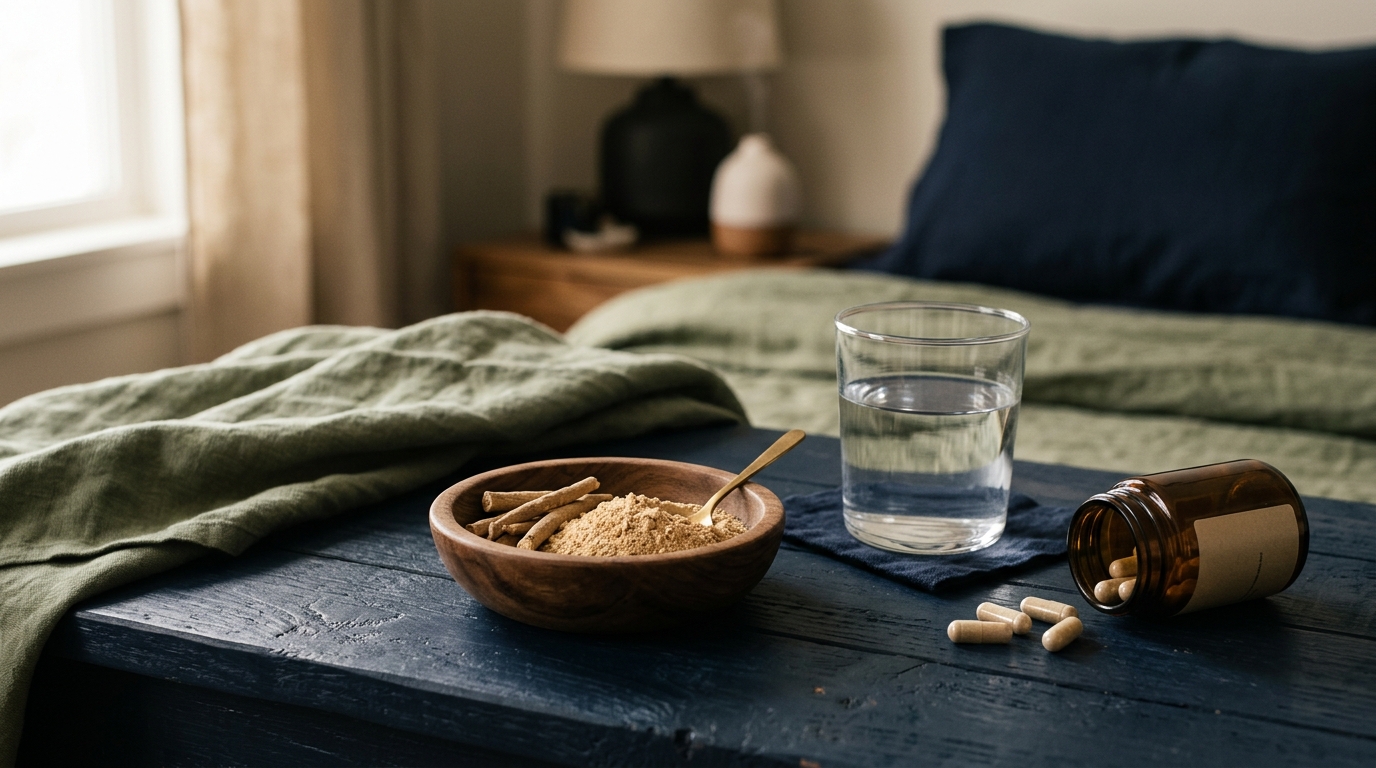
Ashwagandha has been used in Ayurvedic medicine for thousands of years, but it's only recently landed on the radar of sleep researchers — and the results are more interesting than most supplement marketing would have you believe.
This isn't melatonin. It won't knock you out. What ashwagandha does is work on the upstream problem that prevents good sleep in the first place: a chronically overactivated stress response.
Here's what the research actually shows, how to use it, and whether it's worth adding to your sleep stack.
What Ashwagandha Actually Is
Ashwagandha (Withania somnifera — note the species name, somnifera, literally means "sleep-inducing") is an adaptogenic herb. Adaptogens are compounds that help the body resist physical and psychological stress — not by sedating you, but by modulating your stress response system.
The primary active compounds in ashwagandha are withanolides, a class of naturally occurring steroids. These appear to influence the hypothalamic-pituitary-adrenal (HPA) axis — the system that governs your cortisol response.
Ashwagandha also appears to interact with GABA receptors in the brain. GABA is your main inhibitory neurotransmitter — the signal that tells your nervous system to slow down. Several studies suggest ashwagandha's withanolides bind to or modulate GABA-A receptors, which may partly explain its anxiolytic (anxiety-reducing) and sleep-promoting effects.
What the Research Shows
The research on ashwagandha and sleep is better than average for the supplement world. A few notable studies:
The 2019 KSM-66 trial (PLOS ONE, Langade et al.) studied 60 adults with insomnia over 10 weeks. The ashwagandha group (300mg KSM-66 extract twice daily) showed significant improvements in sleep onset latency, total sleep time, sleep quality, and morning alertness compared to placebo. The improvements were larger in the participants with highest subjective sleep complaints.
A 2021 meta-analysis in PLOS ONE pooled five randomized controlled trials (n=400). The conclusion: ashwagandha supplementation significantly improved sleep quality, mental alertness upon waking, and anxiety levels. Effect sizes were moderate — meaningful, but not comparable to pharmaceutical sleep aids.
A 2020 study in Medicine looked specifically at healthy adults (not insomnia patients) and found that 120mg/day of ashwagandha extract over 6 weeks improved self-reported sleep quality and reduced sleep latency. This is noteworthy because most sleep supplements only show effects in clinically impaired populations.
What distinguishes ashwagandha from most sleep supplements is that it appears to work through stress and anxiety reduction — not sedation. This makes it particularly useful for the large subset of poor sleepers whose core problem is a mind that won't shut off.
The Cortisol Connection
To understand why ashwagandha helps sleep, you need to understand the cortisol problem.
Cortisol is your primary stress hormone. It follows a natural rhythm: high in the morning (helps you wake up and feel alert), gradually declining through the day, and reaching its lowest point around midnight — when you should be in deep sleep.
Chronic stress, overwork, late-night screen exposure, and poor lifestyle habits can flatten or disrupt this rhythm. When cortisol stays elevated into the evening, it directly interferes with sleep by:
- Suppressing melatonin production
- Keeping your core body temperature elevated (you need it to drop to fall asleep)
- Maintaining sympathetic nervous system activation ("fight or flight")
Multiple studies show ashwagandha reduces morning cortisol levels in chronically stressed adults by 15–30%. If your cortisol is the problem keeping you awake, this is meaningful.
One study (Chandrasekhar et al., 2012) found that participants taking 300mg of ashwagandha root extract twice daily showed a 27.9% reduction in serum cortisol after 60 days, alongside significantly reduced stress scores, compared to placebo.
This is also why ashwagandha pairs well with other sleep strategies. Fixing your cortisol rhythm doesn't replace good sleep hygiene — but it removes a significant obstacle to it working.
Who Is Most Likely to Benefit
Ashwagandha is not the right tool for every sleep problem. It's most likely to help if:
Your sleep suffers during stressful periods. If you notice your sleep degrades when work gets intense, around deadlines, or during emotionally difficult stretches — that's a cortisol/stress signature. Ashwagandha targets that mechanism directly.
You have trouble winding down mentally. Racing thoughts, difficulty "switching off," lying awake replaying conversations — these are signs of an overactivated stress response that adaptogens address.
You sleep reasonably well most of the time, but not during high-stress stretches. Ashwagandha works better as a steady-state intervention than as an emergency fix. People who are chronically stressed but not acutely in crisis tend to see the most consistent results.
You're already doing the basics. Ashwagandha is not going to overcome a bedroom that's 75°F, blue light exposure until midnight, and an erratic sleep schedule. Supplements work at the margin — not in place of fundamentals.
If your sleep problem is primarily physical (sleep apnea, restless legs, pain), or if you fall asleep fine but wake repeatedly, ashwagandha is less likely to be the leverage point.
Dosage and Timing
The research-backed range is 300–600mg/day of a standardized root extract, typically delivering 5–8% withanolides. The two most studied proprietary extracts are KSM-66 (root-only, 5% withanolides) and Sensoril (root and leaf, 10% withanolides).
Dosing options:
- Single evening dose (300–600mg): Most common for sleep. Take 30–60 minutes before bed.
- Split dose (150–300mg morning + 150–300mg evening): Better for overall stress management and cortisol rhythm normalization.
The evidence slightly favors split dosing for stress reduction and single evening dosing for direct sleep outcomes. If your primary goal is sleep, start with a single 300mg dose 45 minutes before bed.
Onset: Don't expect immediate effects. Most people who respond to ashwagandha report noticeable changes in sleep quality after 2–4 weeks of consistent use. The HPA axis adaptations take time to accumulate. If you're judging it after 3 days, you're not getting valid data.
Ashwagandha KSM-66 600mg is one of the most studied formulations available. Look for third-party testing certification on whatever brand you choose — ashwagandha supplement quality varies widely.
Stacking with Other Sleep Supplements
Ashwagandha works well alongside several other evidence-backed supplements:
Magnesium Glycinate is probably the most logical pairing. Magnesium regulates GABA signaling and helps muscles relax, while ashwagandha reduces cortisol and stress reactivity. They work through different but complementary mechanisms — and magnesium deficiency is extremely common in people under chronic stress. Magnesium Glycinate 400mg is well-tolerated and well-absorbed. Take both 30–60 minutes before bed.
For more on why magnesium works and how to dose it, read Magnesium for Sleep: Does It Actually Work?.
L-Theanine (from green tea) promotes alpha-wave brain activity — the relaxed but alert state. It pairs well with ashwagandha for people whose core sleep problem is an overactive mind. L-Theanine 200mg before bed is low-risk and well-studied.
What to avoid combining: Ashwagandha + pharmaceutical sedatives (benzodiazepines, Z-drugs) without medical guidance. The additive effect on GABA signaling is real and could be problematic. Discuss with a doctor if you're on prescription sleep medication.
Side Effects and Who Should Avoid It
Ashwagandha is well-tolerated in most healthy adults at standard doses. Common mild side effects include:
- Digestive upset (take with food to reduce)
- Mild drowsiness, especially at higher doses
- Occasional headache, particularly in the first week
Avoid ashwagandha if:
- You're pregnant or breastfeeding
- You have autoimmune conditions (Hashimoto's, lupus, MS) — ashwagandha may stimulate immune function
- You have thyroid disorders — some evidence suggests it can affect thyroid hormone levels
- You're on immunosuppressants, sedatives, or thyroid medications without consulting a doctor
Rare but documented: elevated liver enzymes with high-dose, long-term use. Stay within the studied dose range (300–600mg/day) and cycle off for a month every few months if using long-term.
The Bigger Picture: Ashwagandha Is One Tool
The research on ashwagandha is legitimately promising — better than most supplements you'll find in the sleep aisle. But it's worth being clear-eyed about what it does and doesn't do.
It doesn't replace melatonin for circadian issues. It doesn't fix sleep apnea. It won't help if your bedroom is too hot, too bright, or too noisy. It won't overcome a schedule that swings by three hours on weekends.
What it does is meaningfully reduce the stress and cortisol load that prevents restorative sleep for a significant portion of chronic poor sleepers. If that's your problem, it's a well-studied, low-risk addition to your sleep stack.
Pair it with magnesium, maintain consistent sleep-wake timing, and get your bedroom environment right. That combination — not any single supplement — is what actually moves the needle on sleep quality.
For a full, structured approach to rebuilding your sleep from the ground up, the Sleep Reset Protocol covers every lever: environment, timing, supplementation, and the behavioral habits that make the difference between sleeping okay and sleeping well.
Frequently Asked Questions
Does ashwagandha actually help you sleep?+
Yes — multiple randomized controlled trials show ashwagandha (especially KSM-66 extract) significantly improves sleep quality, reduces time to fall asleep, and increases total sleep time. It works primarily by reducing cortisol and modulating GABA receptors, not by sedating you directly.
When should you take ashwagandha for sleep?+
Take 300–600mg of a standardized root extract 30–60 minutes before bed. Some people prefer a split dose (morning and evening) for overall stress management, but a single evening dose is most practical for sleep-specific use.
How long does ashwagandha take to work for sleep?+
Most people notice meaningful improvements in sleep quality after 2–4 weeks of consistent daily use. The adaptogenic effects on cortisol and stress response build gradually — do not judge effectiveness after only a few days.
What is the right dose of ashwagandha for sleep?+
The research supports 300–600mg per day of a standardized extract (KSM-66 or Sensoril). Higher doses have not been shown to produce better sleep outcomes and increase the risk of side effects. Look for supplements standardized to 5–10% withanolides.
Can you take ashwagandha with magnesium for sleep?+
Yes — this is one of the most well-supported supplement stacks for sleep. Magnesium works on GABA signaling and muscle relaxation while ashwagandha reduces cortisol and stress reactivity. They address different mechanisms and complement each other well. Take both 30–60 minutes before bed.
Keep Reading
Sleep Smarter Editorial Team
Our editorial team researches and writes evidence-based sleep content grounded in peer-reviewed science. All articles reference established sleep research from sources including the NIH, AASM, and Sleep Foundation.